The ROI of Memories: Why Experiences Beat Cash for Top Performers
The ROI of Memories: Why Experiences Beat Cash for Top Performers
Why Incentive Travel Is Reshaping Reward Strategy
Companies are rethinking how they recognize and motivate top performers. Across mid-market and Fortune 100 organizations, traditional cash rewards are proving less effective at creating lasting impact.
In response, more leaders are investing in high-touch incentive travel programs that celebrate achievement in a more meaningful way. Unlike cash, a well-designed travel experience creates emotional connection, reinforces company values, and leaves a lasting impression long after the program ends.
The Psychological Advantage of Travel Incentives
People do not remember compensation in the same way they remember exceptional experiences. Cash is often viewed as part of earnings, while travel is experienced as recognition. That distinction matters.
Current findings:
• Cash is perceived as compensation.
• Travel is perceived as a gift.
• Utilitarian rewards are spent on routine liabilities.
• Experiential rewards are remembered and retold.
The value of travel incentives begins well before departure. Anticipation builds excitement. The experience itself creates a sense of recognition and belonging. Long after the event, the memories remain connected to the company that made them possible. For executives and HR leaders, that extended emotional arc is what makes travel incentives so powerful.
The ROI Gap Between Travel and Cash Rewards
The business case is just as compelling as the emotional one. Research from the Incentive Research Foundation (IRF), including a controlled experiment involving Goodyear Tires, highlights the measurable advantage of non-cash rewards.
Comparative Metrics:
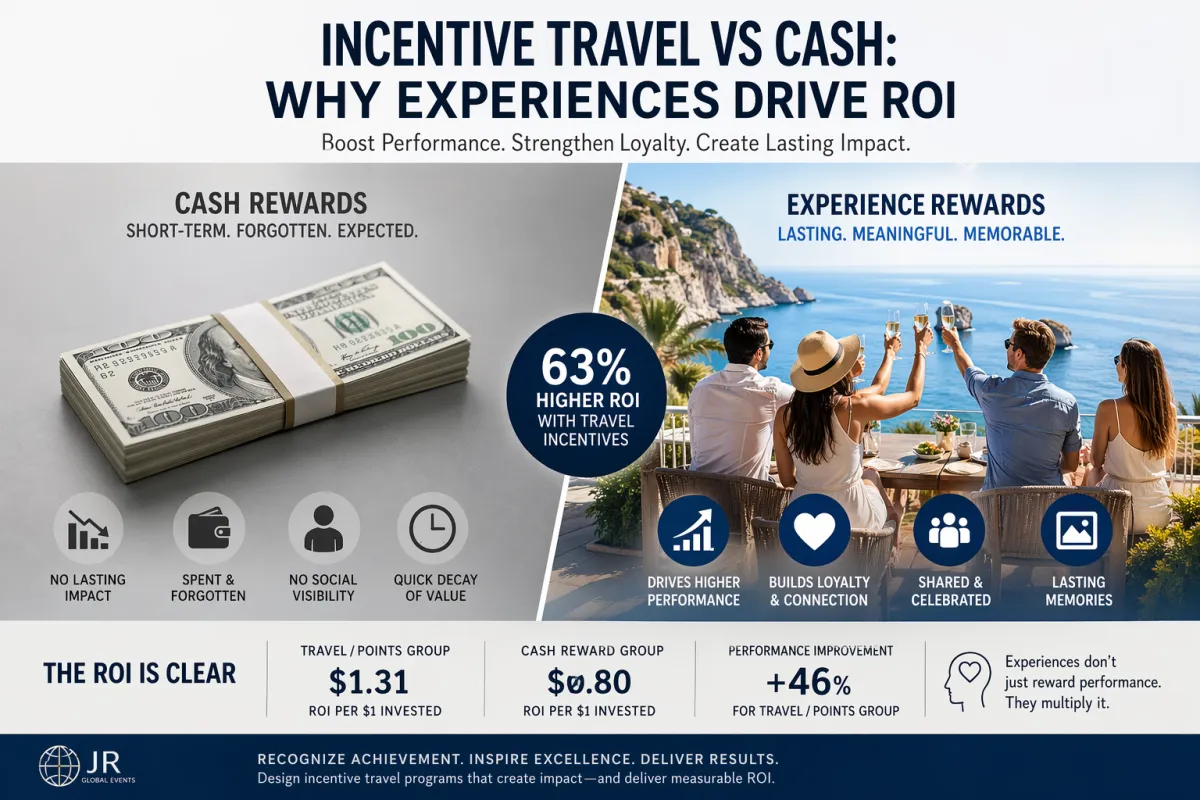
• Points/Travel Group Performance: +46% improvement.
• Points/Travel Group ROI: $1.31 return per $1.00 invested.
• Cash Reward Group ROI: $0.80 return per $1.00 invested.
In this study, non-cash rewards delivered a 63% higher return on investment than cash. They also helped encourage broader engagement and stronger performance across product categories. For organizations focused on both growth and culture, travel incentives offer a rare combination of emotional resonance and financial return.
Why Cash Rewards Fall Short
Cash has value, but it rarely creates meaning. Once it is deposited, it is often absorbed into everyday expenses and quickly disconnected from the achievement it was meant to recognize. Over time, employees may begin to see it as an expected extension of compensation rather than a memorable reward.
Negative Conditions Identified:
• Lack of trophy value.
• High decay rate of emotional impact.
• Zero social visibility.
• Comparison risk among peer groups.
Because cash leaves little emotional imprint, it does not build the same sense of loyalty or pride. It also does little to support broader strategic meeting objectives, such as strengthening culture, rewarding excellence, or reinforcing brand connection.
The Lasting Value of Memorable Experiences
The impact of cash tends to end when it is spent. The impact of travel often grows over time.
Cognitive Decay Analysis:
• T+0 Days: Reward received.
• T+30 Days: Funds expended on household costs.
• T+90 Days: Source of reward forgotten.
By contrast, travel incentives create lasting memories that participants continue to associate with the organization that recognized them. Those moments are shared with colleagues, friends, and family.
Stories are retold. Photos are revisited. The experience becomes part of how employees remember both their achievement and the company behind it.
Why Standard Rewards No Longer Work
For top performers in sectors like technology and finance, generic rewards no longer feel distinctive.
Today’s workforce places greater value on personalization, recognition, and experiences that feel thoughtfully designed. That is why more organizations are turning to white-glove hospitality to engage and retain their most important talent.
Sector-Specific Trends (2025-2026):
• 55% of technology leaders prioritize unique experiences.
• 39% aim to establish emotional connections through travel.
• 81% of organizations use travel for employee retention.
• 70% of organizations use travel to attract Gen Z and Millennial talent.
As employee expectations evolve, standard bonuses and commodity rewards are becoming less effective.
A tailored experience signals care, intention, and prestige in a way that traditional rewards cannot.
How to Put an Experience-Led Reward Strategy into Action
Turning recognition into a meaningful experience requires more than selecting a destination. The most effective programs are built with intention, aligning every detail with business goals, audience expectations, and brand standards. That is where JR Global Events brings value.
Execution Protocol:
• Creative concepting.
• Detailed logistics management.
• On-site production.
• International program scaling.
From executive-level gatherings to large-scale incentive experiences, each program is designed to feel effortless for attendees and strategic for the organizations behind it. With a focus on VIP hospitality and seamless delivery, the result is a reward that feels exceptional at every touchpoint.
Conclusion: Memories Deliver Stronger ROI
Cash may serve an immediate purpose, but experiences create lasting value. The IRF data makes the financial case clear, and the human case is even stronger: travel incentives help people feel recognized, connected, and inspired in ways cash rarely can.
For executives and HR leaders looking to strengthen performance, loyalty, and culture, thoughtful incentive travel is more than a reward. It is a strategic investment in people.
Contact JR Global Events to design a program that delivers both memorable experiences and measurable results.